
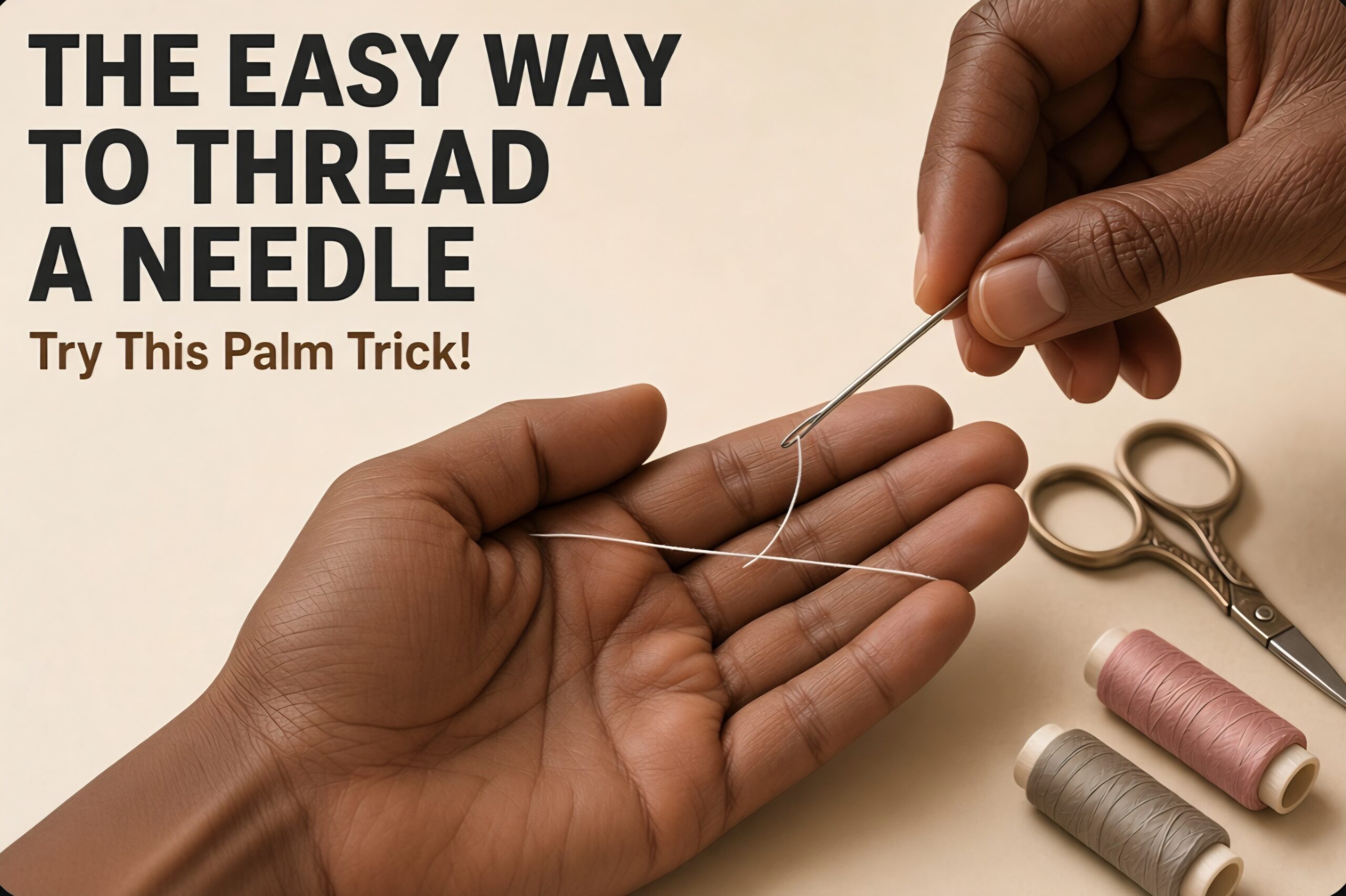
If you’ve ever squinted at a tiny needle eye while the thread frays into a fuzzy mess, you’re not alone. For many people, threading a needle is the most frustrating part of sewing.
This post may contain affiliate links. As an Amazon Associate, I earn from qualifying purchases at no extra cost to you.
But there’s a surprisingly clever trick that’s gone viral for a reason: you can thread a needle by rubbing it across the palm of your hand.
It looks like magic, takes just a few seconds, and doesn’t require a needle threader. Here’s how it works—and why it actually works.
Why this trick works
The secret isn’t luck, it’s friction.
When the thread is stretched across your palm, rubbing the eye of the needle over it creates just enough pressure for a tiny loop of thread to pop through the hole. Instead of pushing the thread into the needle, the needle catches the thread for you.
It’s one of those old sewing tricks that feels surprisingly satisfying once you learn it.
How to thread a needle using your palm
You’ll only need:
- A sewing needle
- Sewing thread
- A pair of scissors
Step 1: Cut a clean thread end
Use sharp scissors to trim the thread. A straight, clean edge works much better than a frayed one.
A pair of precision embroidery scissors gives a much cleaner thread end than household scissors, making threading noticeably easier.
Step 2: Lay the thread across your palm
Stretch the thread across the center of your palm with your opposite hand. Keep it fairly taut, but don’t pull so hard that it digs into your skin.
Step 3: Place the needle eye on the thread
Hold the needle between your thumb and index finger with the eye touching the thread, not the pointed end.
Step 4: Rub back and forth
Gently rub the needle across your palm several times. After a few strokes, you’ll notice a tiny loop of thread sticking through the eye.
Pull the loop, and your needle is threaded!
Watch for these common mistakes
| Mistake | Fix |
|---|---|
| Frayed thread won’t catch | Trim the end again with sharp scissors |
| Thread is too loose | Keep it gently stretched across your palm |
| Using the needle point | Make sure the eye is rubbing the thread |
| Pressing too hard | Use light, even pressure instead |
Does it work every time?
It usually does especially with standard cotton or polyester sewing thread. Very thick embroidery floss or extremely slippery nylon thread may need a few extra attempts.
If you struggle with tiny needles, good lighting and a contrasting background (like white paper) also make a big difference.
If you have trouble seeing tiny needle eyes or your hands aren’t as steady as they used to be, self-threading needles are a great alternative. Instead of threading through a small hole, the thread slips into a tiny slot at the top of the needle with gentle pressure.
They’re especially useful for:
- Quick clothing repairs
- Beginners learning to sew
- Anyone with reduced eyesight or limited hand dexterity
Bonus tip: Make threading even easier
Before you start, run the last centimeter of thread between your fingertips to flatten it. Even if you don’t use the palm trick, a flattened thread slips through much more easily than a fluffy one.
Make Small Sewing Jobs Easier

Once you’ve mastered the palm trick, you’ll probably find yourself reaching for a needle more often. Keeping a few basic sewing supplies together means you’re ready when a button comes loose, a small seam needs attention, or a piece of clothing needs a quick repair.
A polyester sewing thread set is particularly useful because you get multiple colors in one package, making it easier to match the thread to different fabrics.
Life School Tip: Choose a thread set with plenty of everyday colors rather than buying individual spools. It’s a simple way to keep your basic sewing supplies organized and ready to use.
Frequently Asked Questions
Does the palm trick damage the needle?
No. You’re rubbing the smooth eye of the needle lightly across your skin, so it won’t dull the point or damage the needle.
Can children use this method?
Older children learning basic sewing can, as long as they’re supervised and taught to keep the pointed end facing away from their hand.
Is this better than a needle threader?
For everyday sewing, it’s often faster. A needle threader is still the easiest option for very small embroidery or quilting needles.

The takeaway
Sometimes the simplest life hacks are the ones worth keeping. The palm threading trick turns one of sewing’s most annoying little tasks into something quick, easy, and surprisingly satisfying.
The next time a needle refuses to cooperate, try rubbing the eye across the thread instead—you might never go back to the traditional method.
Leave a Reply